Spiritual mechanics for founders who don’t like to follow
What would your life be like if you designed – and optimized– your own spiritual practice? Would you feel more accomplished, connected, disciplined, helpful, loving1? Could a daily spiritual practice make the world a better place?
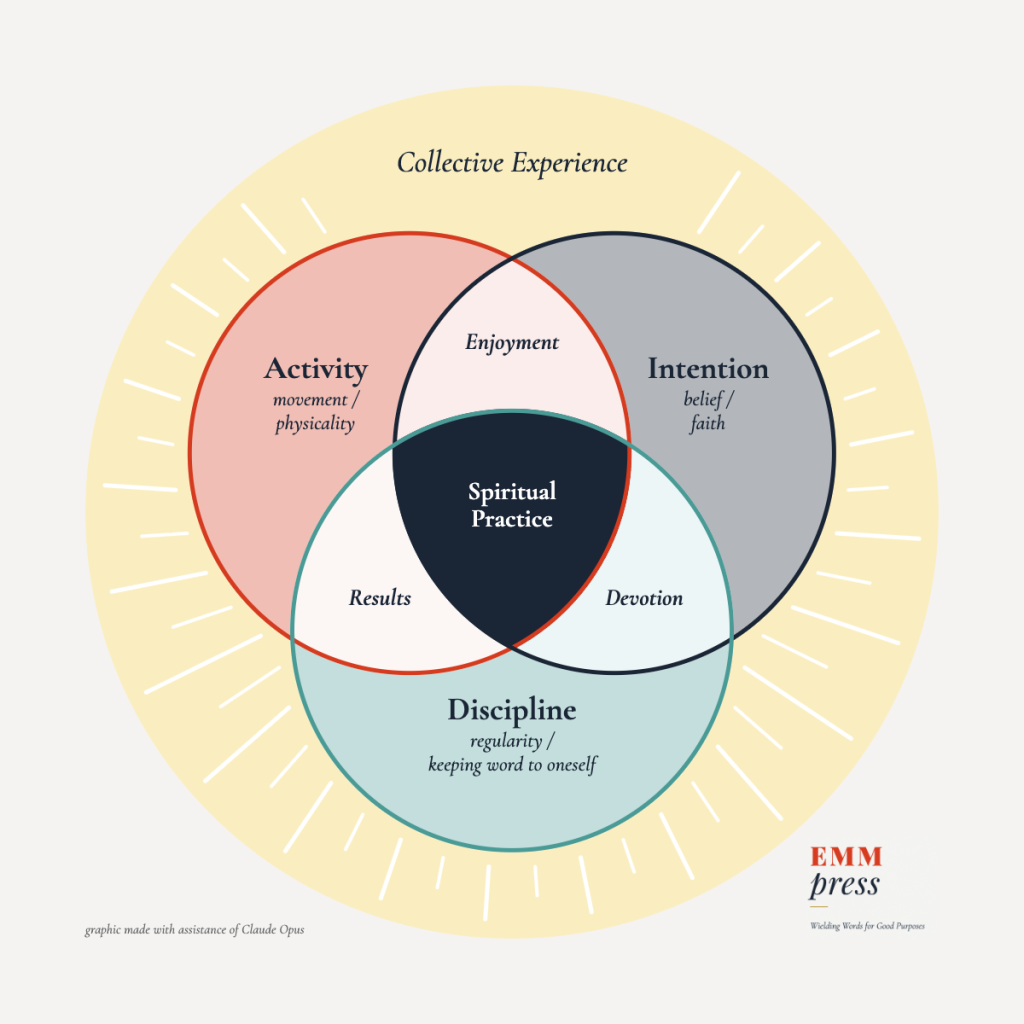
For this piece, let’s define a spiritual practice as:
- a activity one does
- with intention and/or faith,
- that makes the doer feel like they are on a natural path, fulfilled, and/or peaceful,
- and supports collective well-being.
If you are a founder-type person, designing and optimizing your own spiritual practice may be as effective than joining in an established one. I say this because
the best kind of spiritual practice is the one you’ll actually do.

For context: I’m writing this morning, because I’m again resisting joining a one hour bowing and meditation. Even though that practice is organized by an amazing band of Zen Buddhists that I love and respect, I can’t seem to make it happen most days.
So instead of the one hour commitment, I nodded gently while saying “good morning Buddha” and added in, “a dab’ll do ya.” To me this means, sometimes one bow done with intention is worth 1000 done from “should.” And the expression also makes me smile: dab is also a dance move.
This is not the entirety of my spiritual practice though it does help get me on my way. Later today I’ll plan to pick up a piece or two of litter, and that will help me feel like I’ve done my part, my own way. Picking up litter is my ultra-optimized practice, designed for sustainability, and easy to do, so I do it.
Keys to making your practice sustainable
- choose a simple, positive activity that requires no special time, place, or rules
- do the thing, but don’t promise yourself or anyone else you’ll do the thing.
- no pledges, no pressure, no prizes
- enjoy yourself and invite others to join you
And for as long as I can get out into nature, and people continue to drop bits o’ trash in inappropriate places, I’ll be in spiritual business, so to speak.
How I crafted this practice 25 years ago
The first time I realized I enjoyed this practice was after I ran a marathon, and realized I loved picking up trash on my training runs as much as the actual running. Endorphins + making the earth a better place = a power hit of happiness. I wanted that to be repeatable, so I kept going with the litter part. And it works.
The action of bending down, picking up litter, made me feel a direct and loving relationship with the Earth. The action was also easy and addictive: picking up litter requires no equipment, gear, time, space, or even a witness. No one needs to join me. No one even has to know. Nothing to do, but do it.
The relationship that got established was between me and the Earth. And that relationship feels amazing.
Then, because I was young and wanted to make some kind of mark on the world, I codified this practice, wrote and posted 7 keys, and carried on feeling fulfilled that I’d done something for the collective too.
Why founders may prefer a design & optimize approach to a spiritual practice.
Designing the way things are done is a hallmark of a certain kind of person. I feel choosing not only the action itself, but also designing the process, timing, and style of action is a definitional aspect of Founder-hood.
In industry, successful founders tend to innovate the style of production, delivery, and even how they handle sales of ‘the thing.’ Same principles can be applied to any practice, optimizing all the variables so it happens more often.
Why Have a Spiritual Practice at all?
In religious contexts, practices are recommended to keep our inner lives, daily lives, minds, bodies, and time aligned with principles of good greater than ourselves. Meditation and recitation of prayer are common daily practices. So are yoga, 12 Steps, tea ceremonies, fasting, bowing, and candle-lighting. Silence in community, like by Quakers, and twirling, like by Dervishes are also practices.
Did you hear that line in Project Hail Mary? Where Gosling asks the project leader, “do you believe in God?” She answers, “it beats the alternative.” It seems to me daily acknowledgement of your faith in something greater than yourself is a necessary mechanic for any practice to work as intended. Honestly, we need help sometimes.
The spiritual practice of going for a walk
If your intention is to meet the day with joy and vitality, that’s a spiritual practice. You are bringing your body (by walking) together with intention (vitality and greeting), for a reason (to feel good). And since feeling good is a natural precursor for doing good – something that buoys up those who feel badly – this can be considered a spiritual practice.
And the doing of any spiritual practice regularly, is discipline. Discipline is powerful stuff. The word comes from the same root as disciple2, and full of meaning across multiple traditions and loaded with emotional “oomph” for most people, whether they think they have inherent discipline or not.
Marrying physical behavior with internal intention also carries authenticity and wholeness. If you do the same thing each day, your practice carries discipline too.
I realize the suggestion of making one’s own spiritual practice may ruffle the feathers of practitioners of long-standing religions. Please know, that is not my intention. I know that if any person finds a way to act on their spiritual connections, they will feel happier. And if they need to design their own way to do something, so it becomes a sustainable routine, so be it.
If you have a practice and would like to optimize to support greater discipline and joy in your life, I’m happy to work with you. Email me anytime, and we’ll set up a paid coaching session or two.
FOOTNOTES & SUB-SUBTEXT
- This kind of love is agape (pronounced in three syllables: a – gahp- pay). This is a word referring to love of a broader sense than romantic, or even filial love. More on origins of the word are here. ↩︎
- Have some run reading the etymology of disciple here. ↩︎